
 Lower cost per invoice with touchless invoice automation
 March 25 | 11:00 AM PT
The Automated, No-Code Data Stack
Learn how Astera Data Stack can simplify and streamline your enterprise’s data management.

Claude Can Now Build Inside Astera Centerprise. Here’s How.

Astera Centerprise is already one of the most AI-forward data platforms available. Its built-in agentic AI creates data models, builds ETL/ELT pipelines, generates source-to-target mappings, orchestrates workflows, prepares data, and deploys schemas to production, all through natural language. You describe what you need; the AI uses real Centerprise tools to build it.
We’ve now connected Centerprise to Claude through the Model Context Protocol (MCP), giving Claude direct access to every tool in Centerprise’s agentic stack. What Claude adds — deep multi-step reasoning, broad contextual understanding, and precise technical planning — transforms what a single conversation can produce.
This makes Centerprise the first AI-native data integration platform that an external frontier model can fully operate. Not advise. Not generate code snippets for. Operate.

What Claude Can Do Inside Centerprise
Claude has access to the same MCP-based tool layer that powers Centerprise’s own agentic AI. That means anything the platform supports, Claude can perform through conversation:
Build data pipelines. Describe what data you need to move, from where, through what transformations, and to what destination. Claude constructs the complete dataflow inside Centerprise using its 200+ built-in transformations, 50+ connectors, and more. What used to take an afternoon of dragging and configuring now takes a single prompt.
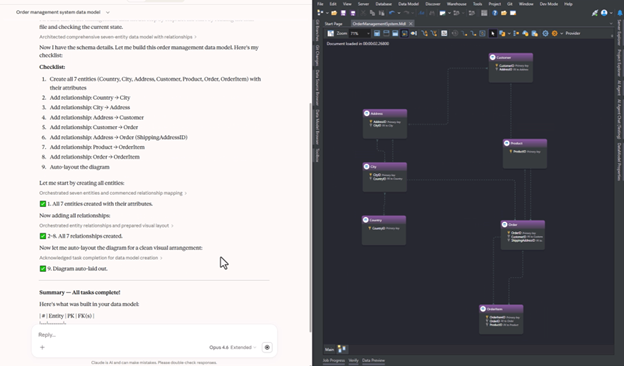
Create and transform data models. Describe a business domain and Claude builds the full model: entities, attributes, keys, relationships. Tell it to convert an OLTP structure into a star schema, and it assigns fact and dimension roles, adds surrogate keys, configures SCD tracking, sets up row identifiers, and marks transaction date keys. These properties directly drive Centerprise’s automated warehouse loading engine.
Generate mappings at scale. Claude works with Centerprise’s mapping engine to align entities and attributes across source and target models using structural matching and semantic analysis. It handles direct matches, recognizes semantic equivalents across differently named systems, and suggests calculated expressions where the target requires derived values.
Drive bulk pipeline generation. With models and mappings confirmed, Centerprise generates pipelines for every source-target pair, with load ordering based on referential integrity, CDC for incremental loads, and automated dimension/fact loading for warehousing. Claude drives this entire workflow, from reverse-engineering a source database to triggering the final generation step.
Orchestrate and schedule. Claude builds workflows that execute pipelines in series or parallel, handle errors, trigger notifications, and run on time-based or event-based schedules.
Every action produces a native Centerprise artifact. You can switch between Claude and the visual designer at any point. Start in conversation, refine visually, come back to Claude for the next step.
How Claude Knows What to Do
Claude isn’t improvising. It has access to structured skills that define how Centerprise works: what operations exist, what parameters they accept, what constraints apply, and how to sequence complex multi-step tasks. When you describe a star schema conversion, Claude doesn’t guess at the steps. It follows the skill’s workflow, selecting the right tools in the right order, the same way an expert Centerprise user would.
Elevating Intelligent Automation
Centerprise built the engine. Claude enhances the intelligence that drives it.
When a frontier reasoning model can directly operate a model-driven data platform, what used to require careful manual sequencing becomes fluid, contextual execution.
This is what AI-native data infrastructure looks like.
Connect Centerprise to Claude and build data artifacts using agentic, natural language-driven automation.
Authors:
farhan.ahmed